
Carrollton Historical Directory Collections
Carrollton's historical directory evidence is spread among the public library, the University of North Texas Portal to Texas History, Dallas Public Library, Denton repositories, and federal directory holdings. That distribution matters. The public pages do not publish a verified shelf-by-shelf run of dedicated Carrollton volumes, so a catalog search or librarian request is the honest next step when a year is missing. Do not assume that a Dallas or Denton volume includes every Carrollton address.
| Collection | Verified years or scope | Keeper or producer | Where held | Access |
|---|---|---|---|---|
| Carrollton Chronicle | 1904–1967 currently browseable; a 1904–1994 microfilm project was announced | Carrollton Public Library and UNT | Portal to Texas History and library | Free pages where digitized; ask the library about later microfilm |
| Union Baptist Church records | Late 1800s–1990s; an 1870 ledger is specifically noted | Carrollton Library / UNT project | Digitized project and local-history help | Confirm the exact item run with library staff |
| Dallas 1955 directory volume | 1955 volume inspected | John F. Worley Directory Co. | Dallas Public Library and Portal collection | Digitized item plus onsite directory research |
| Dallas urban telephone and criss-cross volumes | Exact Carrollton years not published | Several historical publishers | Dallas History & Archives | Print or microfilm, with catalog and staff follow-up |
| U.S. directory collection | Primarily 1861–1960 across more than 1,200 places | Library of Congress collection | Library of Congress | Microform and electronic collection access |
These are different kinds of evidence. A directory is a compiled listing, a newspaper is a dated publication, and a cemetery or church record may identify a family connection without proving a street residence. For a Carrollton search, note the repository, volume year, page or image reference, and whether the record was read onsite, through a library license, or in an open digital collection.
Research note. A listed year describes a specific collection or volume, not proof that every Carrollton household appears in it.
Carrollton Chronicle Directory Evidence
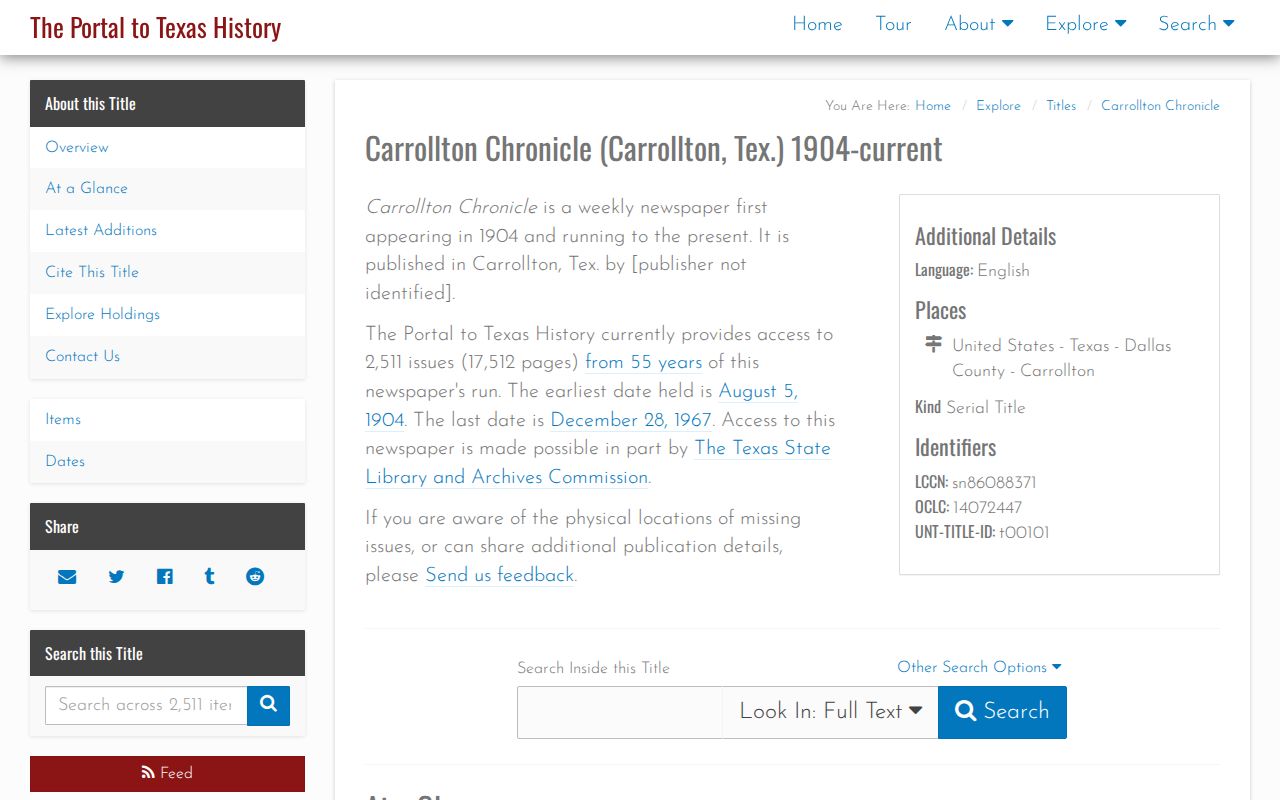
The Carrollton Chronicle is the strongest open local companion to historical listings. UNT's title record currently reports 2,511 issues and 17,512 pages, from August 5, 1904 through December 28, 1967, mostly provided by Carrollton Public Library. A 2013 library announcement described digitization of Chronicle microfilm from 1904 to 1994, but the title record's online run is shorter. Treat the latter date as the currently browseable range, not as evidence that every later reel is online.
UNT's Carrollton Chronicle title record shows the digitized collection that can be searched beside a Carrollton directory lead.
Use a surname with an address, spouse, church, school, or business term when OCR misses a name. Advertisements, social notices, births, deaths, and civic items can help place a directory entry in time, but they should be checked against the original page image and another record before identifying a household.
Collection note. The Chronicle's announced microfilm project is broader than the current online title range, so ask before assuming a missing issue is unavailable.
Carrollton Directory Research Rooms
When a digitized result stops, switch channels rather than filling the gap with guesses. Carrollton Public Library provides Newspapers.com Texas Edition, Gale News, and Texas Digital Sanborn Maps. Remote use requires the library-card username or number and PIN or password through its authentication system; in-library use is the fallback. The database scope can be useful even when a particular Carrollton issue or directory year has not been confirmed online.
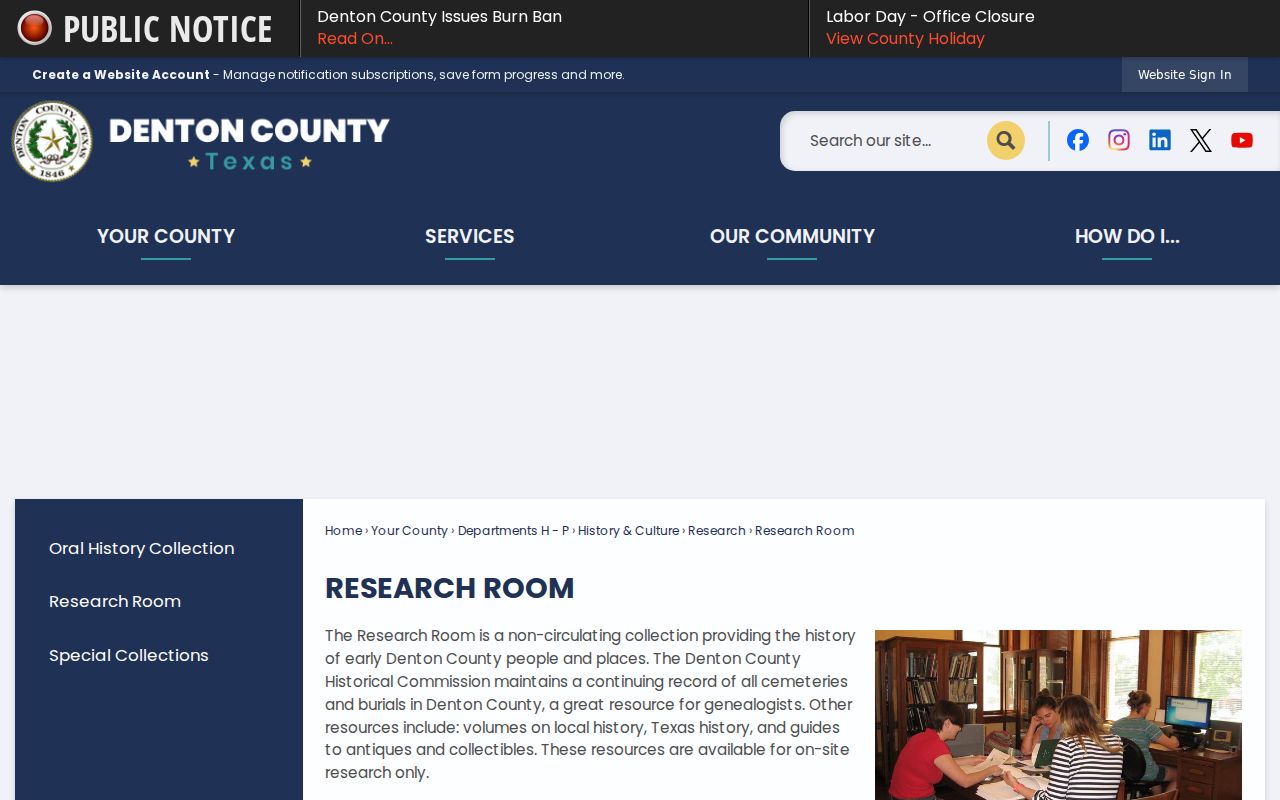
Dallas History & Archives is the nearer major directory shelf for the metro area. Its official description includes city, telephone, and criss-cross directories, yearbooks, more than 1,500 print or microfilm newspapers, and its Portal links. For Denton-side context, the Denton County Office of History and Culture Research Room has local-history volumes, cemetery and burial material, photographs, clippings, and special collections. It is on the first floor of the Courthouse-on-the-Square at 1 Courthouse Drive, Denton; hours are Monday through Friday, 9 to 4, and Saturday, 11:30 to 2:30. Materials are non-circulating, appointments are encouraged for large or special requests, and nothing is pulled in the last half hour.
The Denton County Research Room page explains the onsite collection route that supplements Carrollton directory work.
Bring the address, surname variants, an approximate year, and any lot or block information already found. That small packet gives a librarian or archivist a better starting point than a request to identify a person from a name alone.
Reading a Carrollton Directory Entry
A printed directory entry should be transcribed, not paraphrased. The Library of Congress describes directory material as personal and professional information mixed with civic, social, religious, and business listings, often arranged by surname and sometimes by address or telephone. The 1955 Dallas volume inspected for this research is a 1,952-page John F. Worley Directory Co. book with resident and business listings, advertisements, and Dallas-area coverage. It is a model for fields to look for, not proof that a particular Carrollton name is in that book.
| Name form | Surname, given name or initials, and any spelling or abbreviation variation printed in the volume. |
|---|---|
| Family notation | A spouse in parentheses or a widow notation when that edition supplies one. |
| Work or business clue | An occupation, employer, proprietor, office, or business affiliation when printed. |
| Address line | Street number, street name, apartment or room reference, and any residence or home notation used by that edition. |
| Telephone or cross-reference | An exchange and number, business category, advertisement reference, or pointer to a street guide. |
- Criss-cross section
- The address-order portion of a directory, used to move from a street and number to the listed occupant or subscriber.
- Householder index
- An arrangement that identifies the main listed person for an address; it does not necessarily name every person there.
- Abbreviation key
- The volume's explanation of its shortened forms and marks. Read or photograph it before interpreting a letter in an entry.
Carrollton Reverse Directory Method
City, telephone, and criss-cross directories answer different questions. Start with the alphabetical portion when the name is known. Start with the street guide or reverse portion when an old number is known, then return to the alphabetical section to test the spelling, initials, spouse notation, and business clue. The page or volume may use different abbreviations from the next year, so carry the edition's key with the transcription.
The digitized 1955 Dallas City Directory is a nearby example of the type of directory object held through Dallas Public Library's collection.
For an address that does not appear, check the street name without assuming the modern suffix, look for a subdivision or nearby landmark, and ask Dallas History & Archives whether a different volume or microfilm reel covers the period. The exact Carrollton reverse-directory range was not found in an official catalog page, so it should be verified through the catalog or staff.
Tracing Carrollton Directories by Household
Follow a household in a controlled sequence. A first listing is a lead, not a complete family record. Copy the name as printed, then preserve the street address, spouse or initials, work clue, telephone detail, volume year, and page. Check the same address in the next and prior available volumes, allowing for changed street labels, postal descriptions, or a move across the Dallas, Denton, and Collin County footprint.
- Find the surname in the earliest accessible alphabetical volume and transcribe its full entry.
- Use the address or criss-cross section to test whether the street and number return the same listed person.
- Check the prior and next volume, preserving each address change rather than treating a gap as a disappearance.
- Pair the directory year with the closest available federal census geography and compare household members, ages, birthplace, and address context.
- Use a Chronicle notice, deed or tax trail, obituary, probate file, church record, or cemetery source to resolve the next move or endpoint.
A missing listing can mean a move, a missed compilation, a changed initial, a different telephone subscription, or a volume that simply does not cover that address. The census and deed trail are independent checks. They are more persuasive than treating an absent entry as proof that the household was gone.
Census with Carrollton Directories
Federal census records currently available for this kind of work run through 1950 under the 72-year release rule. Pair a directory address with the closest census before deciding that two similar names are the same person. Census returns add household relationships, ages, birthplaces, and enumeration geography, while the directory can give a more frequent address or telephone clue between census years.
Carrollton's boundaries and descriptions change over time. An address may be recorded as rural, township, village, or part of a later incorporated city. Search the enumeration district with the street, nearby rail or town-square language, church name, or subdivision clue.
| 1878 | Carrollton's first post office opened, a useful identifier in early local references. |
|---|---|
| 1900 | The Myers town-square plat shaped the historic core and can explain an older square or plat description. |
| 1903–1904 | The Frisco railroad arrived, and the currently digitized Chronicle run begins in 1904. |
| 1922 | The interurban connected Dallas and Denton, adding another travel and address-context clue. |
These dates are timeline anchors for interpreting older local descriptions, not replacements for an address match.
Carrollton Directory Gaps and Fallbacks
Use the access path that fits the missing piece. For a current library database, try Carrollton Public Library remotely with a valid card and PIN, then use the library in person. For an unlisted metro directory year, search Dallas History & Archives' catalog and request help with print or microfilm holdings. For Denton-area historical context, use the onsite Research Room. UNT's Portal provides free digitized items, while Library of Congress directory holdings provide a wider national check.
For a city-held historical item not published online, make a focused written request to Carrollton's City Secretary under the Texas Public Information Act, Tex. Gov't Code ch. 552. Identify the record, date range, department, and preferred format. The city describes a 10-business-day process to release, clarify, or seek an Attorney General ruling, and its listed fees and possible estimate or deposit rules can apply. A request cannot require the city to create a new historical analysis, but it can be a useful route to an identified record series.
Access note. Keep the catalog record, page image, or request date with each result because online collections and portal certification screens can change.
Carrollton Directory Landmark Terms
Older Carrollton listings do not always read like a modern street search. The city history ties the historic core to the Town Square, three rail lines north of the square, the post office, churches, schools, cotton gins, and later gravel activity. Those names are useful controlled vocabulary for the Chronicle, directory advertisements, plats, and land indexes. Search Perry, Warner, Union Baptist, Highland Baptist, Old Red, Town Square, Katy, Cotton Belt, Frisco, gravel, and Carrollton Brick alongside a surname or legal description.
This local history also explains why an address trail can shift from farm, depot, square, church, or survey language to a subdivision address. Record the landmark as a search term, then bridge it to a lot, block, abstract, or modern parcel before treating it as the same location. The three-railroad and town-square story is context that helps locate a record, not evidence that a named person was present.